

G.657A2 UAV fiber reel deployment review with bend-radius and routing-condition considerations.
As UAV fiber reels become smaller and routing paths become tighter, the fiber standard alone is no longer enough to judge deployment readiness.
A fiber may be marked as G.657A2. That is useful information. But the real question is how that fiber behaves after it is wound into a reel, routed through a narrow onboard path, guided through a payout structure, connected to an interface, and tested under the project’s actual bending conditions.
For UAV fiber reel projects, the risk does not usually start with the wording on a datasheet.
It starts when the fiber path is forced into a compact mechanical design and still needs to keep the communication link within an acceptable loss range.
That is why G.657A2 should not be treated as a simple sourcing label. For UAV fiber reel applications, it should be treated as part of the deployment boundary.
The better question is not only:
“Is it G.657A2?”
The better question is:
“Under what bending, routing, winding, and test conditions does this fiber path remain within acceptable loss?”
For UAV integrators, fiber reel buyers, and communication system teams, that difference matters.
A qualified fiber label does not always equal a deployment-ready fiber path.
Why “Is It G.657A2?” Is Not Enough
In many UAV fiber reel discussions, G.657A2 is used as a quick sign of bend-insensitive fiber. That is not wrong. It is just incomplete.
A UAV reel is not a loose fiber sample. It is a constrained mechanical path and a communication path at the same time. The fiber may be wound tightly, routed through compact structures, guided through a moving payout path, and handled repeatedly during deployment.
So the customer’s risk is not only fiber selection.
It is fiber path behavior.
If the project team only checks the standard name, several risks may remain hidden:
- the reel structure may create tighter bends than expected;
- the routing path may introduce local pressure points;
- the payout guide may affect the fiber during movement;
- connector transition areas may become loss-sensitive;
- the link may pass sourcing review but require more testing during integration.
These problems do not always appear during quotation. They often appear later, after the reel design has been selected, the prototype has been built, or the customer is already preparing acceptance tests.
At that point, the issue is no longer only optical loss. It can become extra validation time, repeated link testing, spool structure changes, delayed approval, and a buyer who starts questioning whether the reel was designed around the real deployment path.
What G.657A2 Tells You — and What It Does Not
ITU-T G.657 defines categories for bend-insensitive single-mode fiber. G.657 A class fibers are designed for compatibility with G.652 applications, and G.657A2 is often discussed where smaller bending conditions may be expected.
For UAV fiber reel buyers, that standard reference is valuable. It gives the project a more relevant starting point than ordinary single-mode fiber in compact routing applications.
But the standard name does not replace project-level review.
It does not automatically confirm:
- the finished reel’s tightest routing point;
- the actual bend radius inside the spool path;
- macro-bending loss under the reel’s geometry;
- the effect of repeated winding and payout;
- the behavior around connector transition areas;
- the test wavelength, number of turns, bending radius, and method used by the supplier.
This is where a purchase decision can look complete on paper but remain unfinished from an engineering standpoint.
The standard describes the fiber category. It does not replace validation of the finished reel path.

G.657A2 should be reviewed against actual UAV fiber reel deployment conditions, not only as a fiber category.
Bend Radius Is a Design Boundary
Bend radius is not a small mechanical detail in compact UAV reels. It is a boundary for link margin.
A long-distance fiber link may look acceptable in a specification table. But once that fiber is wound into a smaller reel, routed through a narrow housing, or guided through a compact payout structure, bending stress can change the optical loss behavior of the path.
That matters because UAV fiber reel applications often face several constraints at the same time:
- limited onboard space;
- compact spool size;
- lightweight reel design;
- narrow routing channels;
- field handling uncertainty;
- project pressure to pass validation quickly.
In this type of project, the fiber standard alone does not control the risk. The reel design decides how much of the fiber’s bend-insensitive performance can actually be used.
A project team should ask:
Where is the tightest bend?
Does the bend radius change during payout?
Is the connector transition area protected from local stress?
Has the finished path been reviewed against the expected deployment condition?
If these questions are not asked early, the risk moves downstream into assembly, testing, or customer acceptance.
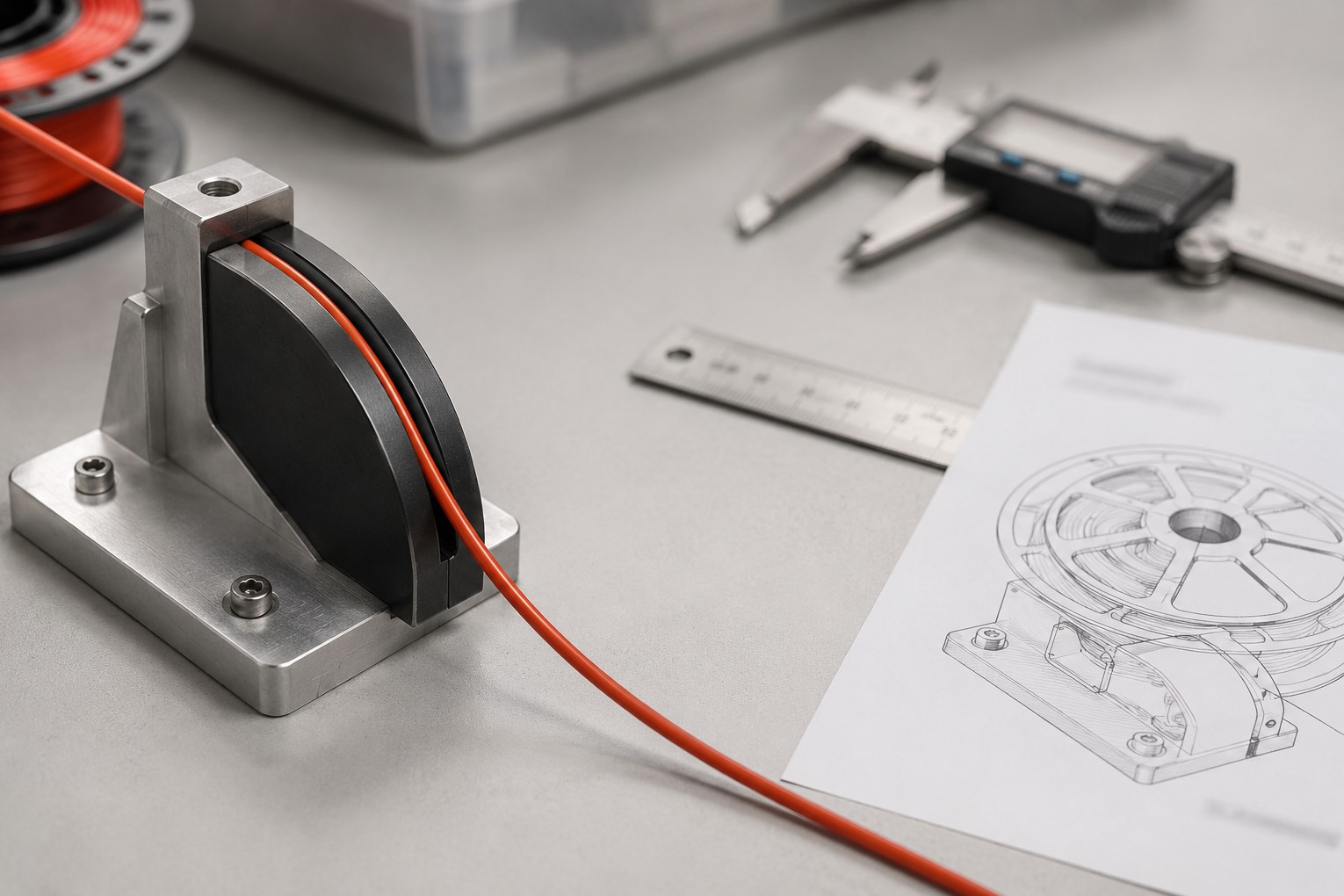
Bend radius should be reviewed before the reel design is locked.
Macro-Bending Loss Needs Test Conditions
Macro-bending loss should not be treated as a vague claim.
It only becomes meaningful when tied to test conditions: bending radius, number of turns, wavelength, and test method. Methods such as IEC 60793-1-47 can support macro-bending loss discussion, but the finished reel still needs to be checked against its actual application.
For UAV fiber reel buyers, this is important because the reel is not only storing fiber.
It is shaping the fiber path.
A compact spool may introduce repeated bending. A payout guide may create a tighter local radius. A connector transition may add stress in one small area. A ground-side reel may be handled differently from an onboard reel.
Each of these details can affect link margin.
This is also where strong-sounding claims become risky. A supplier should not say that G.657A2 removes attenuation risk. It does not. A more responsible position is that G.657A2 can help manage bend-related loss risk when it is matched with proper bend-radius control, spool routing, and inspection conditions.
Specific NovaLynx finished-reel macro-bending loss data at a target bend radius, wavelength, number of turns, and test method should be confirmed by the technical team. Need verification.
Where Fiber Path Risk Appears
Fiber path risk does not always appear as broken fiber. More often, it appears as reduced margin.
That makes it harder to catch during early sourcing review.
In UAV fiber reel projects, the most common risk points are usually not the standard name itself. They are the places where the fiber path is forced to behave under mechanical pressure.
Reel Winding
If the spool geometry is too tight or the winding path is not controlled, the fiber may face bending conditions that were not considered during procurement.
Fiber Payout
During deployment, the fiber is not static. The payout direction, guide structure, and handling behavior can all affect the fiber path under movement.
Connector and Transition Areas
Even when the main spool looks acceptable, the transition from reel to interface can create local stress. These points should be reviewed before the design is locked.
Compact Onboard Routing
Small UAV platforms often force the communication path through limited space. If the routing path creates tight bends or pressure points, the risk moves directly into platform assembly.
Acceptance Testing
A link may pass basic inspection but show unstable behavior during longer deployment or final acceptance. This can trigger re-testing, mechanical adjustment, shipment delay, or reel redesign.
For buyers, the practical issue is simple: a fiber label can be confirmed in one email, but a deployment problem can consume weeks of engineering time.

Fiber path risk can appear around reel winding, payout guide, connector transition, and compact onboard routing.
The Real Buyer Question
A better purchasing question connects the fiber standard to the actual use condition.
Instead of only asking:
“Is this G.657A2?”
Buyers should ask:
- What bend radius is expected inside the reel structure?
- Where is the tightest routing point?
- What macro-bending loss test conditions are available?
- What wavelength and number of turns were used in testing?
- Is the fiber source traceable?
- Is the finished reel inspected before shipment?
- Does the routing path stay within the project’s acceptable loss boundary?
This separates a material claim from a deployment-aware reel design.
For UAV communication projects, that difference matters. The question is not whether the fiber is good in isolation. The question is whether the fiber path remains controlled inside the actual reel and platform.
How NovaLynx Approaches G.657A2 for UAV Fiber Reel Applications
NovaLynx does not need to position G.657A2 as a standalone selling point.
For UAV fiber reel applications, the fiber category should be reviewed together with spool structure, routing path, bend-radius control, source traceability, and inspection before shipment.
This approach helps buyers review the communication path as a working system instead of a single material line item.
NovaLynx can support customers in clarifying:
- whether G.657A2 is suitable for the reel application;
- how compact spool routing may affect link margin;
- what bend-radius conditions should be reviewed;
- where routing pressure may appear;
- what sourcing and inspection information should be checked before shipment.
This does not remove the need for project-specific validation. It helps reduce blind spots before the reel moves into integration.
The value is not claiming that every bend is safe.
The value is helping the customer define which bending and routing conditions should be checked before the reel design is locked.
What Buyers Should Confirm Before Choosing a UAV Fiber Reel
Before choosing a UAV fiber reel, buyers should review more than the fiber name.
A practical review should include:
- fiber category and compatibility requirements;
- fiber source and traceability;
- reel size and spool structure;
- minimum bend-radius expectation;
- compact routing path;
- connector transition area;
- macro-bending loss discussion;
- test wavelength and method;
- finished product inspection before shipment;
- project-specific acceptance requirements.
This does not make the buying process slower. It makes the buying process less blind.
The goal is to reduce late-stage uncertainty: fewer surprises during assembly, fewer questions during acceptance, and less risk of redesign after the reel has already been selected.
For UAV fiber reel projects, a small review before sourcing can prevent a larger engineering issue later.
Conclusion: Treat G.657A2 as a Deployment Boundary, Not a Label
G.657A2 matters in UAV fiber reel applications. But its value is not in the label alone.
Its value appears when the fiber is selected, routed, wound, inspected, and validated according to the deployment conditions it will actually face.
For UAV integrators, communication system teams, and fiber reel buyers, the better question is not simply whether a product uses G.657A2 fiber.
The better question is whether the entire fiber path remains within acceptable loss under the bending, routing, spool, and deployment conditions of the project.
Do not lock the reel design before the bend-radius and routing boundary are reviewed.
FAQ
1. Is G.657A2 fiber always suitable for UAV fiber reel applications?
Not automatically. G.657A2 is a relevant fiber category for bend-sensitive applications, but suitability still depends on bend radius, spool design, routing path, connector transition areas, and test conditions. The finished reel should be reviewed against the actual project requirements.
2. Does G.657A2 mean there is no attenuation risk?
No. G.657A2 can help manage bend-related loss risk, but it does not remove attenuation risk under all bending or routing conditions. Any loss claim should be tied to specific test conditions such as bend radius, wavelength, number of turns, and test method.
3. Why does bend radius matter in a UAV fiber reel?
Bend radius affects how the fiber behaves when it is wound, routed, or pulled through a compact path. If the bend radius is too tight for the actual design, the link margin may drop and extra testing or mechanical changes may be required.
4. What should buyers ask before choosing G.657A2 fiber for a UAV reel?
Buyers should ask about fiber source, G.652 compatibility, minimum bend-radius expectation, spool routing, macro-bending loss test conditions, connector transition points, and shipment inspection. The key is to confirm deployment conditions, not only the standard name.
5. Can NovaLynx confirm finished-reel macro-bending loss data?
Project-specific test data should be confirmed by NovaLynx technical documentation or the technical team. If a customer requires a target bend radius, wavelength, number of turns, or test method, those details should be reviewed before quotation or validation. Need verification.
Review the Fiber Reel Requirements Before Selection
Before selecting a UAV fiber reel, check more than the fiber label.
Send NovaLynx your expected fiber length, spool size, routing path, target deployment distance, and bend-radius concerns.
NovaLynx can help review what should be checked before G.657A2 fiber is selected for your UAV fiber reel project.
Edited by NOVALYNX on June 2026