
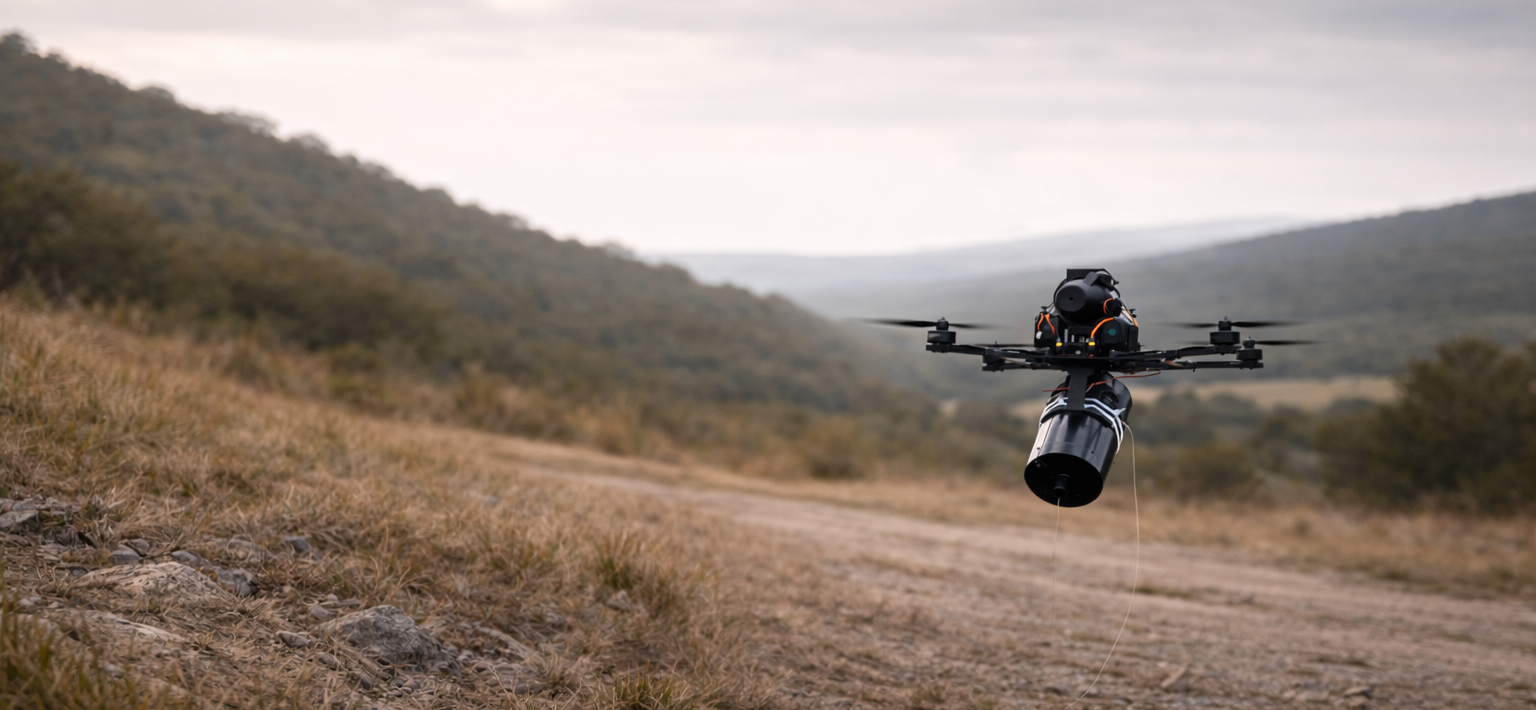
RF Is Failing in Real UAV Missions — Why Hybrid Fiber Architecture Is No Longer Optional
RF is no longer merely “unstable” in real UAV missions — it is becoming structurally unreliable.
For years, RF communication has been the default for UAV systems. But in today’s operational environments, especially in electronic warfare (EW) scenarios and high-interference zones, RF is no longer just degraded. It is failing in ways that directly impact mission execution.
Typical failure modes now include:
- Signal loss under jamming
- Unstable video transmission
- Interrupted control links
- High re-flight rates
In these conditions, communication is no longer just a performance issue.
It becomes a mission risk.
The Real Cost: Failed Missions, Not Lost Signals
Most UAV communication systems are still evaluated by conventional metrics such as:
- Range
- Bandwidth
- Power
But in real deployment, the true cost is something else entirely:
Mission failure caused by unreliable communication.
Every failed flight can result in:
- Operational delays
- Increased exposure risk
- Higher lifecycle cost
- Loss of customer confidence
In many scenarios, the consequence is not simply financial — it is strategic.
What Leading Integrators Are Changing Right Now
Across multiple regions and programs, a clear architecture shift is already happening:
RF-only → Hybrid RF + Fiber
Why?
Because RF alone can no longer guarantee:
- Stability under interference
- Predictable system behavior
- Continuous control at range
This is not an isolated adjustment. It is a broader transition in how reliable UAV communication is being designed.
Hybrid Architecture Is Redefining Communication Roles
The new model does not eliminate RF.
It redefines its role.
Fiber optic link → Primary backbone
- Anti-jamming
- Stable, high-bandwidth transmission
- Near-zero latency
RF link → Secondary layer
- Mobility
- Redundancy
- Tactical flexibility
This is the key shift:
Reliability is no longer assigned to RF.
That responsibility is increasingly moving to fiber.
Why Fiber Is Becoming the Secure Communication Layer
Fiber offers something RF fundamentally cannot:
Physical isolation from electromagnetic interference.
That means:
- No jamming
- No interception
- No spectrum congestion
In real UAV missions, this translates into:
- Stable video
- Reliable control
- Predictable system behavior
This is why fiber is no longer being viewed as an optional enhancement. It is becoming the secure layer for mission-critical communication.
This Is No Longer an Upgrade — It Is a Requirement
Fiber is not simply a performance improvement.
It is becoming a baseline requirement for:
- EW environments
- 3–50 km missions
- High-value payload operations
- Autonomous systems
As mission complexity increases, communication architecture can no longer depend on RF alone.
If You Don’t Adapt, the Gap Widens Quickly
If your platform remains RF-first, the risks grow fast:
- Failure rates increase
- System reliability declines
- Tender competitiveness drops
- Integration challenges expand
The industry shift is already underway.
The question is no longer whether this transition will happen.
It is whether your system will keep up.
NovaLynx: Enabling the Fiber-First™ Transition
NovaLynx supports UAV manufacturers with:
- Fiber optic reel kits using G.657.A2, field proven in demanding environments
- Rapid integration into existing UAV platforms
- Hybrid communication architectures tailored to specific mission profiles
Our focus is simple:
Reliable communication where RF cannot be trusted.
Request a Technical Consultation
If your UAV must operate in contested environments, RF alone is no longer enough.
Request a technical consultation with NovaLynx to:
- Evaluate your current communication risks
- Assess fiber integration options
- Define a hybrid architecture roadmap
Contact us to receive a tailored solution within 48 hours.
Edited by NOVALYNX on March 2026