
A communication system can have a defined backup path and still have incomplete handover logic. The missing piece is often not the failover itself, but the decision about what happens afterward.
When the primary communication path degrades, the system needs evidence that justifies moving traffic away from it. But once the secondary path is active, the opposite decision should not simply be triggered by reversing the original threshold. A path that appears to have recovered is not necessarily ready to carry traffic again.
That distinction matters for UAVs, UGVs, and field robotic platforms operating through changing geometry, movement, obstruction, interference, or other conditions that can make communication quality fluctuate over time.
A complete handover policy needs to answer three separate questions:
- What evidence is sufficient to leave the primary path?
- What keeps traffic on the secondary path while recovery remains uncertain?
- What different evidence is required before controlled re-entry to the primary path?
The engineering problem is not merely switching from Path A to Path B. It is defining the full state-transition logic between them.
A Failover Policy Is Not Complete Without a Return Condition
Many handover discussions focus on one event: When should traffic leave the primary communication path? That is necessary, but it defines only half of the policy. Once the secondary path becomes active, the system still needs rules governing whether, when, and under what conditions the primary path can be trusted again.
Leaving and Returning Are Different Engineering Decisions
The decision to leave the primary path is normally driven by evidence of degradation. Depending on the system, that evidence may include changes in packet delivery, heartbeat continuity, acknowledgement behavior, application traffic, interface status, or other link-health indicators.
The departure question is: Has primary-path performance degraded enough that remaining on it creates more operational risk than switching away?
The return decision asks something different: Has the primary path recovered with enough stability and confidence to justify moving traffic back?
These are not inverse versions of the same question. A degradation event may justify departure quickly, while re-entry may require stronger or more persistent evidence because returning too early can expose the system to repeated switching.
That is why leaving a degraded primary path and returning to it should not use the same evidence by default.
When Should Traffic Leave the Primary Communication Path?
Define a Degradation Condition, Not a Momentary Symptom
Communication quality is rarely static. A moving platform may see short-lived variations that disappear without requiring any architectural response. If every transient change becomes a failover trigger, the system may react to noise rather than meaningful degradation.
The first design task is to distinguish between:
- a temporary variation;
- sustained degradation;
- degradation severe enough to justify a path transition.
This does not require a universal threshold. A fixed threshold copied from another platform may be inappropriate. The relevant condition depends on what traffic the path carries, what health information is available, and what behavior the platform can tolerate.
Combine Evidence With Persistence
A failover trigger should normally be more structured than a single momentary indication. An engineering team might evaluate a combination of delivery failures, missing acknowledgements, heartbeat interruption, interface or link-health status, application-level behavior, and persistence of the degraded state.
The same trigger also does not have to apply identically to every traffic class. Control, telemetry, status, video, and other higher-rate application traffic may have different tolerance for degradation and may therefore require different evidence or persistence criteria before migration. A condition acceptable for status traffic should not automatically be assumed appropriate for another traffic role.
This does not mean every traffic class requires an independent handover architecture. It means the policy should avoid assuming that one degradation rule is automatically valid for all traffic carried by the system.
The important principle is that a failover trigger should represent confirmed degradation, not simply the first sign that conditions have changed.
Make the Departure Decision Observable
If traffic leaves the primary path, engineers should be able to identify what evidence was observed, how long the condition persisted, which rule was satisfied, and when the transition was initiated. Without that visibility, troubleshooting becomes difficult because the final state is visible but the decision process is not.
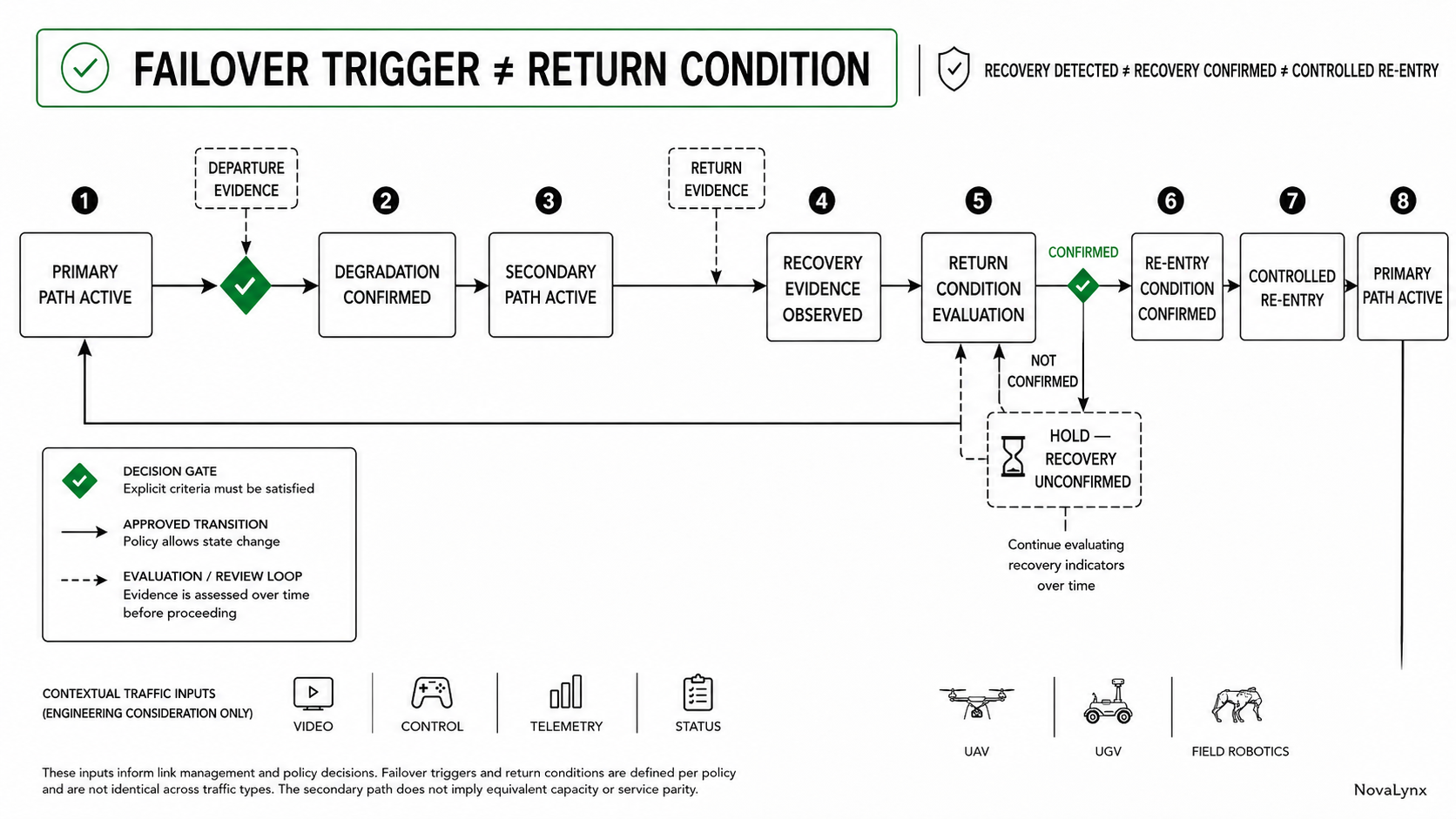
PRIMARY PATH ACTIVE → DEGRADATION CONFIRMED → SECONDARY PATH ACTIVE
That transition defines departure. It does not yet define recovery.
Why the Secondary Path May Need to Remain Active
Once failover occurs, there is often a temptation to treat the secondary path as a temporary state that should be exited as soon as the primary path becomes visible again. That can create unstable handover behavior.
Primary-Path Visibility Is Not Recovery Confirmation
Suppose a degraded path begins showing healthy status again. That may indicate genuine recovery, but it may also represent a brief improvement, an intermittent condition, recovery at the monitoring layer but not yet at the application layer, or a path only marginally above the original failover boundary.
If traffic returns immediately, the same path may degrade again moments later. The system can then move back to the secondary path, detect another temporary recovery, and repeat the process. The problem is uncontrolled state transition.
Use a Recovery-Unconfirmed Hold State
A more disciplined policy allows the secondary path to remain active while the primary path is evaluated:
SECONDARY PATH ACTIVE → RECOVERY EVIDENCE OBSERVED → HOLD — RECOVERY UNCONFIRMED
The hold state separates “The primary path appears better.” from “The primary path has demonstrated sufficient recovery to accept traffic again.”
During this period, the system avoids treating preliminary recovery evidence as authorization for re-entry.
This also avoids another assumption: failover does not by itself mean that every traffic class must migrate identically or that the secondary path is intended to reproduce the entire primary-path load. Traffic migration still depends on the communication roles and limits defined for the system.
What Evidence Should Count as a Return Condition?
The return condition is the decision gate that determines whether the primary path can re-enter active service.
Recovery Evidence Should Not Mirror Failover Evidence
If the system leaves the primary path after a particular degradation condition persists, it may seem logical to return as soon as that condition disappears. But disappearance of failure evidence is not the same as confirmation of stable recovery.
A return policy may require stronger confidence, longer persistence, confirmation from more than one health indicator, successful traffic exchange, application-level readiness, or a combination of these signals. The exact implementation depends on the platform and the traffic being managed.
The key point is asymmetric decision logic: departure evidence answers whether the system should stop trusting the primary path; return evidence answers whether it should start trusting it again.
Use Hysteresis to Separate the Two Decisions
Handover hysteresis is one mechanism for separating departure and return decision boundaries. It can help reduce repeated transitions when communication conditions remain close to a switching threshold.
It may be implemented through different thresholds, persistence requirements, evidence combinations, or a combination of those mechanisms. The purpose is not simply to make re-entry slower, but to reduce the chance that minor changes near a boundary repeatedly trigger opposing transitions.
Without sufficient separation, a system may move PRIMARY → SECONDARY → PRIMARY → SECONDARY even though the operating environment has not meaningfully stabilized.
Recovery Detected Is Not Recovery Confirmed
This distinction should be explicit in both implementation and testing:
RECOVERY DETECTED → RECOVERY OBSERVED OVER TIME → RE-ENTRY CONDITION CONFIRMED
Only the final state authorizes the next transition. Engineers can then distinguish between early evidence and actual permission to move traffic.
Controlled Re-entry Is a State Transition, Not a Toggle
Even after the return condition has been satisfied, re-entry should be treated as an engineering state rather than an instantaneous conceptual switch.
PRIMARY PATH ACTIVE → DEGRADATION CONFIRMED → SECONDARY PATH ACTIVE → RE-ENTRY CONDITION CONFIRMED → CONTROLLED RE-ENTRY → PRIMARY PATH ACTIVE
Why Controlled Re-entry Matters
The primary path may be healthy enough to qualify for re-entry while the system still needs to manage traffic migration deliberately.
Depending on the communication architecture, re-entry may involve restoring forwarding behavior, confirming interfaces are ready, re-establishing application traffic, synchronizing state, or observing the transition before declaring primary-path operation fully restored. Not every platform requires all of these steps.
The important point is that qualification for re-entry and completion of re-entry are separate states.
This creates a clearer validation boundary. Instead of asking only whether the system eventually returned to the primary path, engineers can ask what evidence authorized the transition, what happened during it, and when primary operation was considered restored.
What Happens When Return Logic Is Weak?
Path Flapping
Path flapping occurs when the system moves repeatedly between primary and secondary paths because the decision boundaries are too sensitive to changing conditions. The instability may come from the transition policy rather than either communication path itself.
Premature Re-entry
A system can return before the primary path has demonstrated stable recovery. Traffic may move back onto a marginal path, experience another degradation event, and trigger another failover. In this case, recovery detection was treated as recovery confirmation.
Secondary-Path Stickiness
The opposite problem is also possible. A system may fail over correctly but remain on the secondary path indefinitely because no explicit return criteria have been defined. The implementation knows how to leave but not what evidence should authorize return.
Ambiguous Handover State
Without explicit states, engineers may struggle to determine whether the system is using the secondary path, observing primary-path recovery, holding because recovery is insufficient, performing re-entry, or fully restored to primary operation. Clear states improve integration and troubleshooting.
How Should Handover and Re-entry Logic Be Validated?
Test Degradation and Recovery Separately
Scenario A — Primary degradation: Does the system detect the relevant condition and leave the primary path as intended?
Scenario B — Primary recovery: After failover, what evidence allows the system to consider re-entry?
These are separate test objectives because they validate different decision gates.
Include Transient, Sustained, and Partial Recovery
A return policy should not be evaluated only under perfect recovery. Useful scenarios include transient recovery that disappears, sustained recovery, unstable or partial recovery, and recovery followed by renewed degradation during re-entry.
These scenarios help reveal whether the policy distinguishes stable recovery from a short-lived improvement.
Record the State Transitions
Useful observations may include the degradation trigger, sequence of state changes, hold-state duration, recovery evidence, re-entry authorization, traffic behavior during transition, and any renewed degradation.
This gives engineering teams something more actionable than a simple “failover passed” result.
Define Acceptance Logic Before the Test
The return condition should ideally be defined before testing begins. Otherwise, the team risks observing a result first and deciding afterward that the behavior was acceptable.
A stronger validation approach defines in advance what triggers departure, what keeps the secondary path active, what qualifies as recovery, what authorizes re-entry, and what invalidates re-entry if conditions deteriorate again.
Handover Logic Review Checklist
- What evidence triggers departure from the primary path?
- How is transient degradation distinguished from actionable degradation?
- How long or how consistently must the degradation condition persist?
- Do different traffic classes require different degradation or migration criteria?
- What keeps traffic on the secondary path while recovery remains uncertain?
- What evidence indicates that the primary path may be recovering?
- What additional evidence confirms that recovery is sufficient for re-entry?
- Is the return condition different from the departure condition?
- Is there sufficient separation between departure and return decisions?
- Is there an explicit HOLD — RECOVERY UNCONFIRMED state?
- Is CONTROLLED RE-ENTRY treated as a distinct transition?
- What happens if primary-path conditions degrade again during re-entry?
- Can each state transition be observed during engineering validation?
If these questions cannot be answered clearly, the communication system may have backup connectivity without having a complete handover policy.
Conclusion: Define the Return Before You Need the Failover
A secondary communication path does not, by itself, define resilience. The engineering value comes from the logic governing how the system moves between states.
A useful handover policy should distinguish degradation detected from degradation confirmed, recovery detected from recovery confirmed, and recovery confirmed from controlled re-entry.
Most importantly, it should not assume that the evidence used to leave a degraded primary path is automatically sufficient evidence to return.
PRIMARY PATH ACTIVE → DEGRADATION CONFIRMED → SECONDARY PATH ACTIVE → HOLD — RECOVERY UNCONFIRMED → RE-ENTRY CONDITION CONFIRMED → CONTROLLED RE-ENTRY → PRIMARY PATH ACTIVE
That sequence turns failover from a simple switching event into a defined, observable, and testable communication-integration policy.
Reviewing Handover Logic for an Unmanned Platform?
For UAV, UGV, and field-robotics communication systems with defined primary and secondary paths, a communication architecture review can examine whether departure conditions, secondary-path hold states, recovery evidence, re-entry criteria, and validation logic are clearly defined before integration testing.
NovaLynx approaches communication architecture reviews through this type of state-transition and handover-logic analysis, with the objective of making the decision process explicit and testable rather than treating failover as a single switching event.
FAQ
What is UAV communication handover logic?
UAV communication handover logic defines the conditions and state transitions governing when traffic leaves one communication path, remains on another path, and later returns. A complete policy includes both failover and re-entry behavior.
What is the difference between a failover trigger and a return condition?
A failover trigger identifies when degradation is sufficient to leave the primary path. A return condition determines when the primary path has recovered with enough stability and confidence to accept traffic again. They address different risks and should not automatically use identical evidence.
Why should a system not immediately return when the primary path recovers?
Initial recovery may be temporary or unstable. Immediate return can cause premature re-entry and repeated switching between primary and secondary paths. A recovery-confirmation stage can help separate temporary improvement from sufficiently stable recovery.
What is hysteresis in communication handover logic?
Hysteresis is one method of separating the criteria used for departure and return. It may use different thresholds, persistence periods, or evidence combinations and can help reduce repeated transitions when conditions remain close to a switching boundary.
How can path flapping be reduced?
Path flapping can be reduced by defining explicit degradation confirmation, recovery persistence, sufficient separation between departure and return criteria, secondary-path hold logic, and separate return conditions rather than switching whenever a single health indication crosses one threshold.
What should be tested before controlled re-entry?
Validation should examine the recovery evidence, persistence of that recovery, readiness of the primary path, behavior during traffic migration, and what happens if degradation returns during the re-entry process. Acceptance criteria should be defined before testing.