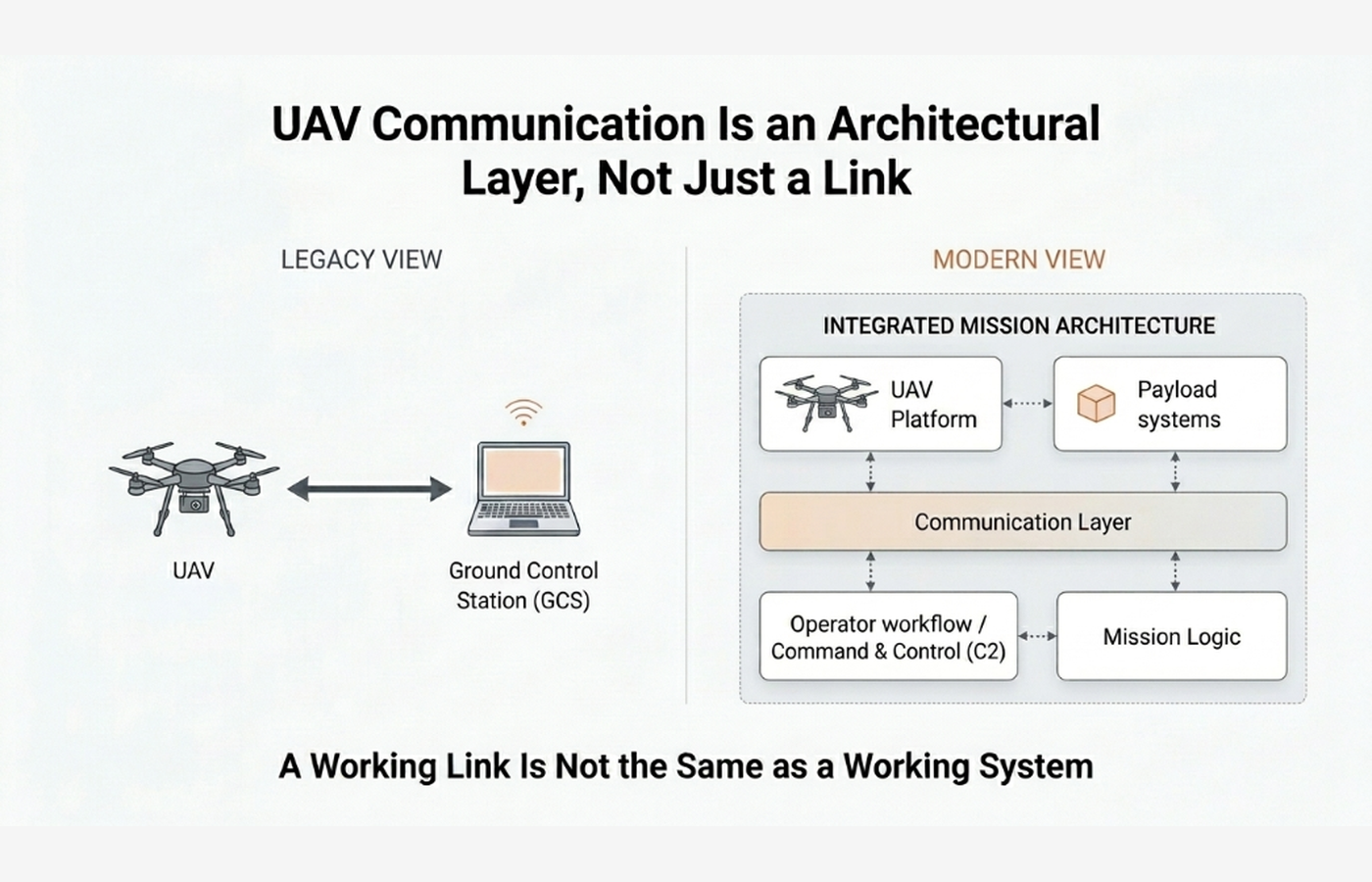
UAV Communication Integration: A Working Link Is Not the Same as a Working System
Most UAV teams are still making the same communication mistake.
They buy communication as if it were a component.
A box. A module. A link between the drone and the operator.
If it passes data, shows video, and responds to commands, it is treated as “solved.”
That assumption is now breaking down.
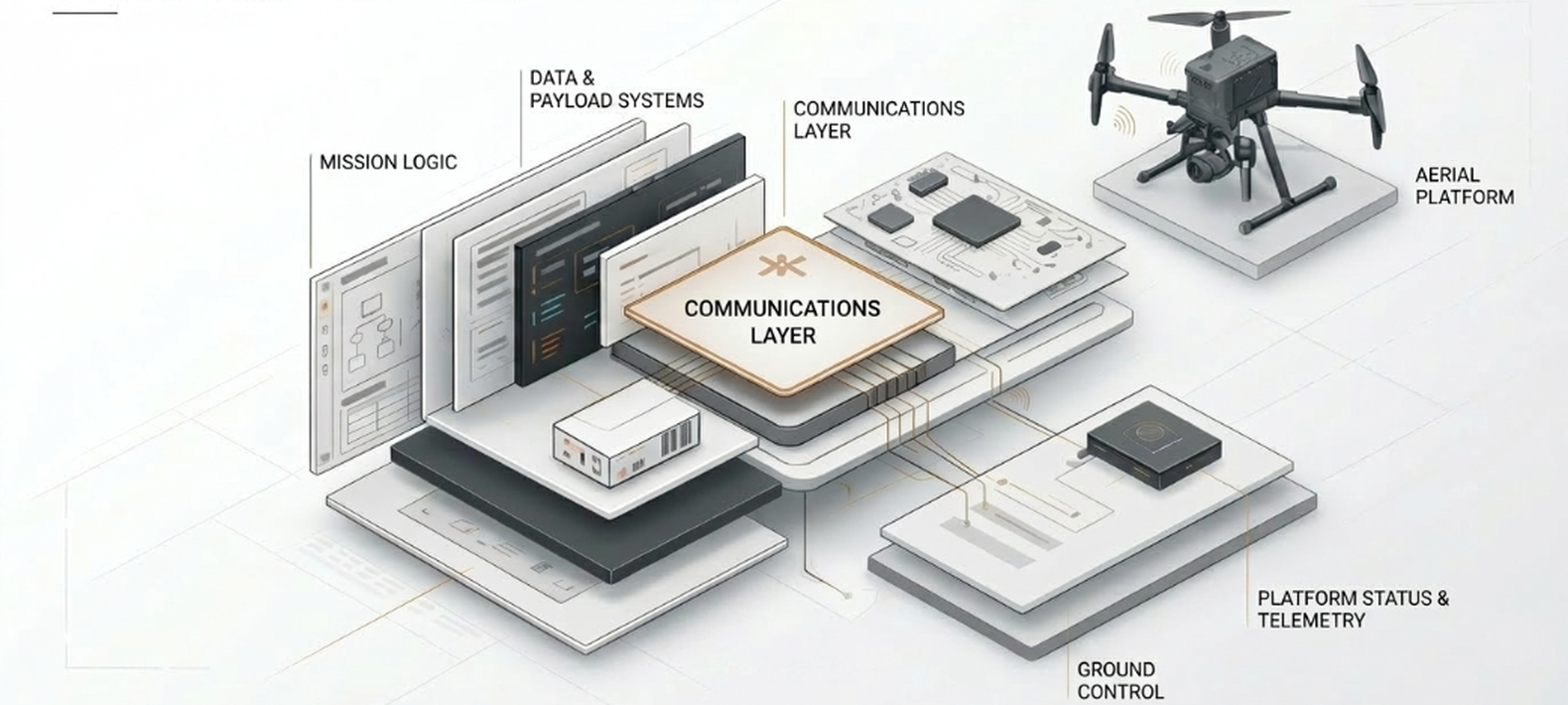
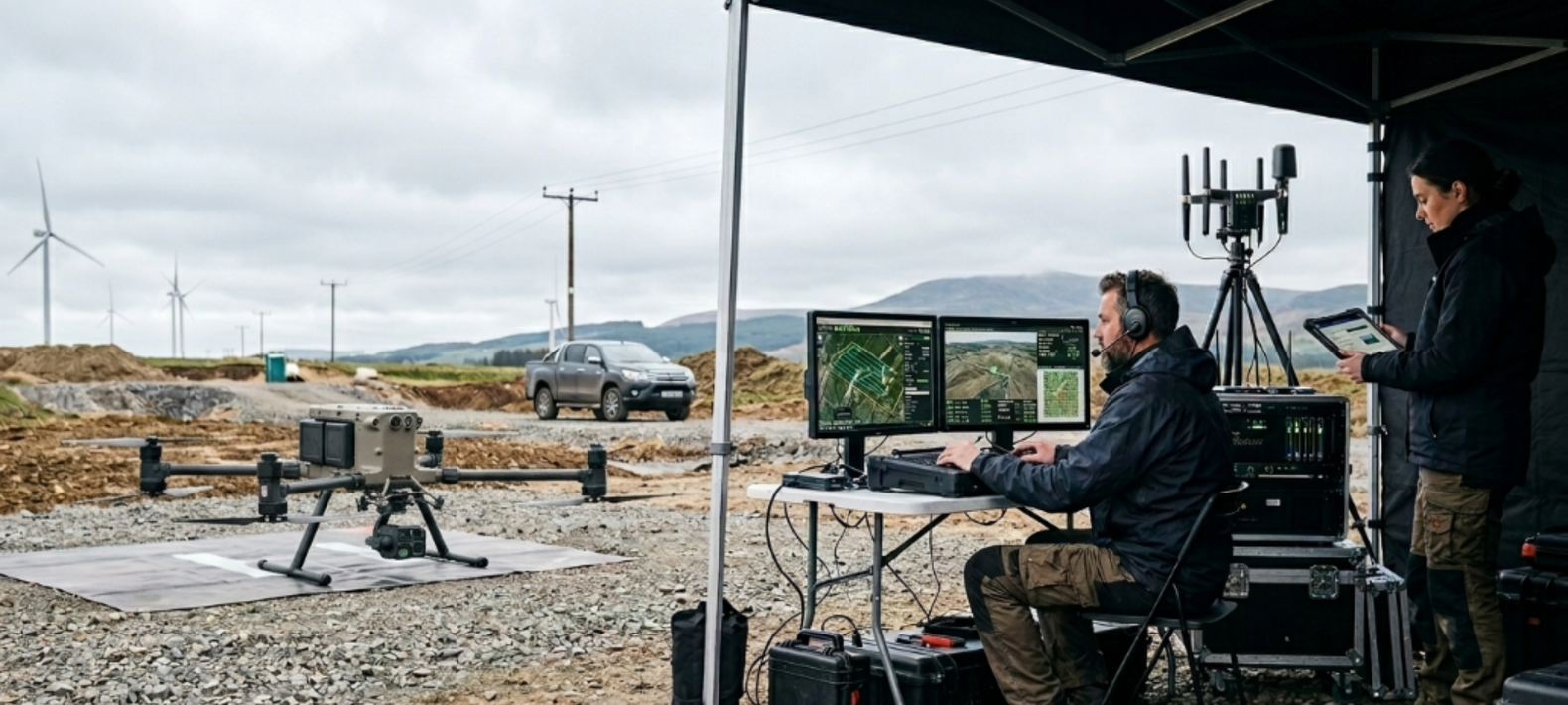
Because modern UAV missions are not built around a single connection. They are built around a system: aircraft, ground control station, payload, operator workflow, and mission logic all working together under pressure.
And when communication is treated like an accessory instead of an architectural layer, the system never behaves as cleanly as it should.
That is the real problem.
The market is still optimizing the wrong thing
Many teams still evaluate communication this way:
- Is the link active?
- Is the feed visible?
- Does the aircraft respond?
Those questions belong to a simpler generation of UAV operations.
Today’s missions—especially ISR, payload-heavy tasks, tactical operations, and integration-driven deployments—need more than signal presence. They need coordination across the mission stack.
A link can be active while the mission is already drifting.
The operator sees video, but trusts it less.
The aircraft responds, but not with the same confidence.
Payload data arrives, but no longer feels tightly aligned with control and timing.
Nothing has collapsed. But the system no longer behaves as one.
That is not a minor issue. It is a design issue.
A “working” link can still create a weak mission system
This is exactly where generic communication products fall short.
Most communication products are built to move data from one point to another. That sounds useful—until the mission becomes more complex and the job of communication expands beyond transmission.
Once the UAV is part of a broader mission stack, the communication layer has to support more than connectivity. It has to support timing, coordination, control confidence, and clean interaction between the aircraft and everything around it.
If the communication layer behaves like a standalone part, the rest of the mission stack pays the price.
And that price usually shows up in ways teams do not like to call failure:
- slower decisions
- weaker operator confidence
- more fragile payload coordination
- less trust in what the system is showing and doing in real time
That is why this is no longer just a link problem.
It is an integration problem.
The real bottleneck is not the aircraft. It is how communication is positioned in the system.
Most UAV teams still integrate around the platform.
They focus on the aircraft, the payload, the flight logic, and the mission software—then assume communication will simply “support” it all.
But that is backwards.
If communication is unstable, loosely integrated, or treated like a removable layer, the rest of the system cannot behave like a coherent whole. You do not end up with an advanced mission stack. You end up with a stack of capable parts held together by a fragile assumption.
That assumption is this:
As long as the link is alive, the mission is fine.
It is not.
The mission is only fine when the aircraft, the control side, and the payload layer remain coordinated enough to be trusted.
Why fiber matters in integration-heavy missions
Fiber matters here not because it is new or impressive, but because it helps solve the right problem.
The issue is not simply “how do we send signal?”
The issue is “how do we reduce communication uncertainty so the mission system stays coherent?”
That is what fiber changes.
It helps turn communication from a variable source of doubt into a more dependable part of the architecture. For integration-heavy operations, that matters more than another performance claim.
Because once the mission depends on clean coordination between aircraft, GCS, payload, and mission systems, communication cannot remain an afterthought. It becomes part of what holds the operation together.
Where NovaLynx is different
NovaLynx is not positioned for teams that simply need a link between a drone and an operator.
It is built for teams that need the communication layer to behave like part of the mission architecture itself.
That is the difference.
Generic communication products move data.
NovaLynx is designed to preserve coordination across control, payload, and mission systems when the mission becomes more complex and less forgiving.
In other words, it does not just connect the UAV.
It helps keep the mission stack coherent.
Final takeaway
If your communication layer still behaves like an accessory, your mission system will never behave like a true system.
Talk to a NovaLynx engineer about communication architecture for integration-heavy UAV operations.
Edited by NOVALYNX on April 2026