A practical framework for reviewing robot communication architecture across RF, fiber, magnetic, and hybrid communication paths.
“Non-RF” does not define an architecture. The right path depends on what each link must carry, where it must operate, how the platform moves, and which new constraints the design can accept and validate.
When a robotic platform reaches the limits of its current RF link, teams often jump directly to hardware.
Should we add another radio?
Should we move video to fiber?
Should we consider magnetic communication?
Should we build a hybrid system?
Those questions start too late.
“Non-RF” only describes what a communication path does not use. It does not define the traffic, distance, latency boundary, movement, routing, interfaces, or validation burden.
A UAV sending video over open terrain, a crawler turning inside a metallic structure, and an ROV carrying inspection data underwater do not face the same communication problem. Even on one platform, control, telemetry, video, diagnostics, and recovery can impose different requirements.
The architecture should therefore begin with one question:
What must each communication path carry, where must it operate, and what new constraint will it introduce?
That question changes the sequence. A reel, radio, fiber type, coil, modem, or transceiver becomes an outcome of the review—not the starting point.
Non-RF Describes a Constraint, Not a Design
Terms such as RF-limited, interference-sensitive, propagation-blocked, underwater, underground, and confined-space describe operating conditions. They do not identify the correct communication path.
A platform may be RF-limited because of terrain, structural obstruction, antenna geometry, spectrum conditions, distance, water, soil, or a metallic enclosure. These conditions affect communication in different ways.
Before selecting a technology, the team must separate the communication roles:
- Command and control
- Telemetry
- Real-time video
- Sensor data and diagnostics
- Recovery or emergency signaling
Video may require sustained throughput. Control may require predictable timing. Telemetry may tolerate a lower data rate. A recovery channel may carry very little data, but it must remain available under a different failure condition.
Combining every function on one path can simplify the system diagram. It can also create an RF-only communication dependency or another single point of architectural exposure.
Separating every function is not automatically better either. More paths mean more interfaces, power consumption, switching logic, and validation work.
The correct architecture is not “one link” or “many links.” It is a deliberate assignment of roles.
Every Path Solves One Constraint—and Introduces Another
RF: Mobility With Environmental Dependence
RF supports movement without a physical route. It can be the most practical primary path when propagation and spectrum conditions are manageable.
Its boundary is environmental dependence. Obstruction, antenna placement, platform orientation, local interference, regulation, and distance can change usable performance.
Fiber: Controlled Capacity Through a Physical Route
Fiber can provide high data capacity, low transmission delay, and a defined optical path that does not depend on RF propagation.
It replaces wireless exposure with physical deployment constraints: storage, payout, bend, drag, snagging, outlet position, connector protection, routing, and recovery.
A fiber specification can be suitable while the platform route is not. That is why fiber routing and bend conditions must be reviewed as part of deployment.
Magnetic Communication: A Specialized Path With Strict Boundaries
Magnetic communication may deserve technical review for selected short-range or lower-data-rate links where conventional RF propagation is restricted.
Its practical boundary depends on distance, coil geometry, alignment, operating medium, power, traffic requirements, and platform structure. These variables must be evaluated for the specific application rather than inferred from a general technology label.
Magnetic communication is not a general replacement for RF or fiber.
Hybrid Communication: Different Paths for Different Roles
Hybrid communication can separate video, control, telemetry, or recovery functions. Its value does not come from adding more technologies. Each path needs a defined role, capacity, activation condition, operator response, and failure boundary.
| Path | What It May Help Address | Constraints That Must Be Accepted and Validated |
|---|---|---|
| RF | Mobility, rapid deployment, no physical tether | Propagation, obstruction, antenna placement, spectrum conditions, interference, and regulation |
| Fiber | High data capacity, low link delay, controlled physical route | Storage, payout, bend, drag, snagging, connector protection, routing, and recovery |
| Magnetic communication | Selected short-range links through specific media, barriers, or confined environments | Distance, data rate, coil placement, alignment, power, medium, and application-specific validation |
| Hybrid communication | Separation of control, video, telemetry, or recovery roles | Additional interfaces, switching logic, power, data prioritization, integration, and test complexity |
This matrix is an architecture-screening tool, not a universal ranking. Final suitability remains application-specific.
Link Success Is Not Platform Readiness
Bench testing is the fastest place to confirm basic communication. It is necessary, but it does not reproduce platform movement, mechanical routing, structural obstruction, tether behavior, deployment, recovery, or operator response.
A fiber link may meet attenuation and traffic requirements while the payout route fails during a turn. A connector may work in a stationary setup but experience repeated bending after installation. A reel may fit inside the available volume while its outlet position creates an impractical route.
The same logic applies to specialized short-range links. A magnetic link may transfer a command through a selected medium yet remain unsuitable for a high-rate sensor stream.
A second path may work independently but still fail as redundancy if the system has not defined when to use it, which data it carries, and what the operator should do.
Four validation levels should be separated:
- Link feasibility: Can the endpoints communicate?
- Interface integration: Can the path connect to the platform’s electrical, optical, and protocol interfaces?
- Operational integration: Does it still work during movement, routing, deployment, and recovery?
- Failure behavior: Is the system response defined when the path degrades or becomes unavailable?
Passing the first level does not prove the fourth.
A Concrete Scenario: Inspection Crawler in a Confined Structure

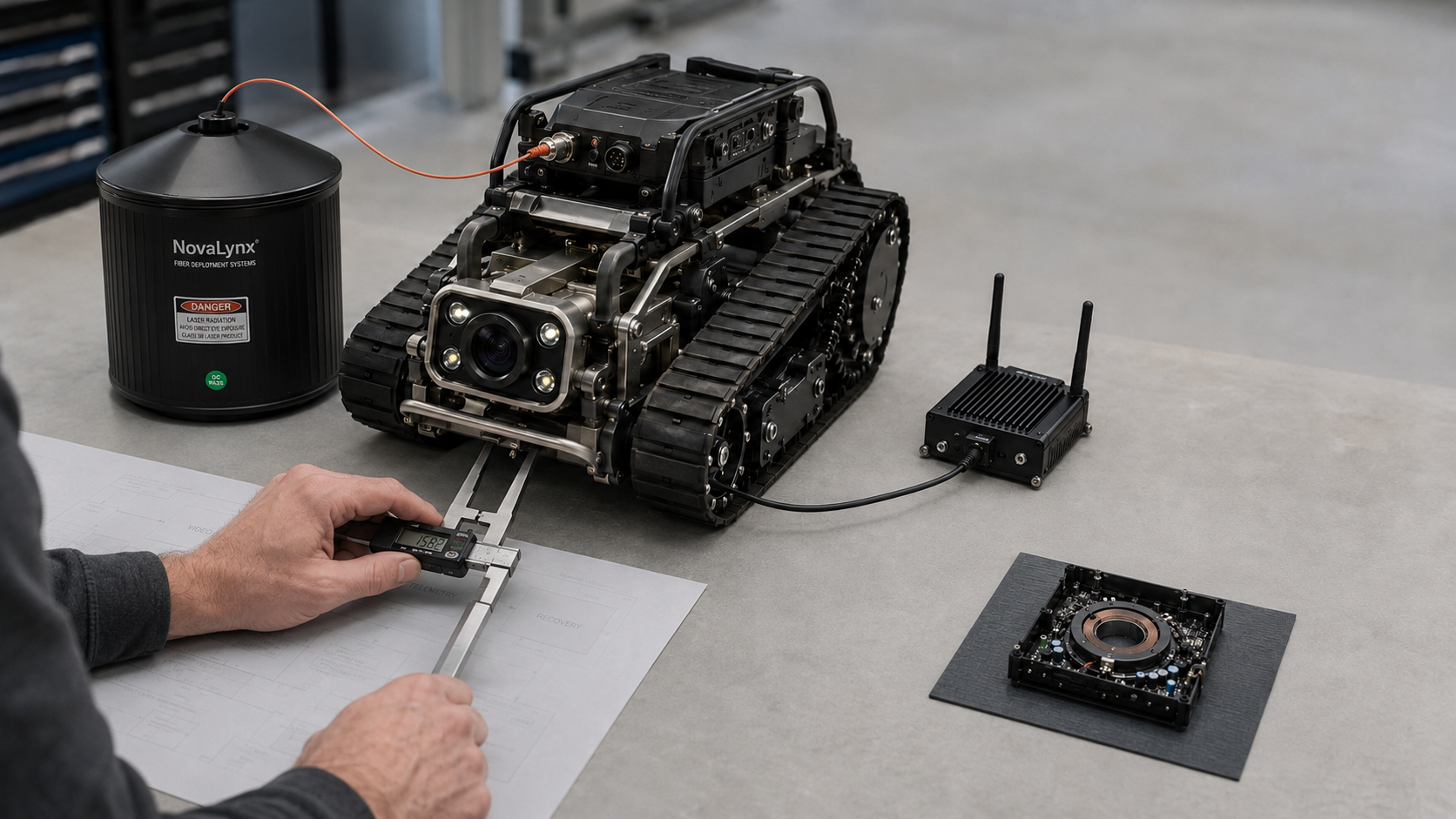
Consider an inspection crawler operating inside a long metallic service tunnel. It needs continuous inspection video, control commands, telemetry, and a low-rate recovery command if the primary path becomes unavailable.
A single RF link is simple, but structural obstruction and changing orientation may make propagation difficult to predict.
Moving all traffic to fiber could provide a controlled high-capacity route. The team must then review reel location, outlet direction, turning behavior, drag, snagging points, connector protection, and recovery if the route becomes blocked.
A specialized magnetic path may be technically relevant for a narrow status or recovery role at selected positions. It would not automatically carry inspection video. Its range, coil arrangement, alignment, power, and interaction with the surrounding structure would require validation.
A hybrid design could assign video and primary control to one path and recovery signaling to another. But “hybrid” alone does not make the system more dependable.
The architecture must still define:
- Which path is primary
- What triggers a change
- Which data remains available
- What the operator sees
- How the platform responds if both paths become limited
The conclusion is not that this crawler must use fiber, magnetic communication, or a hybrid system. The conclusion is that its communication roles should not be treated as one undifferentiated requirement.
Seven Questions Before Selecting the Hardware
1. What Must Each Path Carry?
Separate control, telemetry, video, sensor data, diagnostics, and recovery. Define which functions are primary, secondary, or emergency-only.
2. What Traffic Must the Path Support?
Identify normal and peak throughput, direction, compression, priority, and acceptable degradation. A low-rate recovery channel and real-time video should not inherit the same requirement by default.
3. What Latency Boundary Actually Matters?
Separate transmission delay from protocol processing, encoding, decoding, control response, sensor processing, and display delay. A low-latency link does not guarantee a low-latency end-to-end system.
4. What Distance and Medium Must Be Crossed?
Review distance together with open air, structures, water, soil, pipes, tunnels, metallic enclosures, and other barriers. The same distance can represent very different communication conditions.
5. How Does the Platform Move?
Account for speed, rotation, turning radius, vertical movement, obstacle interaction, repeated route crossing, tether behavior, deployment, and recovery.
6. How Will the Path Be Routed and Integrated?
Review module or reel position, outlet direction, connector access, bend conditions, protection, antenna or coil placement, installation volume, weight, power, heat, interfaces, and protocol conversion.
7. What New Constraint Does the Path Introduce?
Document what the path solves, what it does not solve, what must be tested, what failure mode remains, and what the platform should do when the path is unavailable.
Role → Environment → Traffic → Route → Integration → Validation
Hardware selection should begin only after these boundaries are clear.
How the Decision Changes by Platform
The same communication path creates different integration pressure on different platforms.
For a UAV, weight, outlet position, payout, drag, turning, and recovery may determine whether a fiber route is practical. RF may remain the correct primary path where mobility dominates and propagation can be managed. UAV fiber communication integration should therefore be assessed at platform level, not by reel capacity alone.
For a UGV or crawler, the route may include sharp turns, debris, repeated direction changes, metallic structures, or limited recovery access. A path that works in a straight test can fail after the platform crosses its own route.
For an ROV, high-rate video and sensor traffic may support a tethered optical path, while water exposure, mechanical load, connector protection, handling, and recovery become central inputs.
For underground or confined-space platforms, conventional RF may face structural or medium-related limits. Fiber, modified RF arrangements, specialized short-range links, or hybrid communication may deserve review. The platform does not merely carry the communication system: its movement, geometry, interfaces, and recovery method are part of that system.
How NovaLynx Reviews Communication Paths
NovaLynx supports early-stage communication-path review and integration discussions.
The purpose is not to force every project toward fiber, magnetic communication, RF, or a predetermined component. It is to identify which paths deserve further engineering evaluation and which assumptions should be resolved before hardware selection.
Starting Inputs From the Customer
A useful first review can begin with four inputs:
- Platform type: UAV, UGV, crawler, ROV, inspection robot, or another robotic system.
- Communication roles: control, telemetry, video, sensor data, diagnostics, recovery, or a defined combination.
- Operating distance and environment: open air, structure, tunnel, pipe, water, underground, confined space, or another environment.
- Movement and integration limits: speed, turns, routing space, power, interfaces, weight, installation volume, and recovery method.
Where available, traffic estimates, video format, latency boundaries, current RF arrangement, existing interfaces, mechanical space, deployment sequence, and observed failure conditions make the review more precise.
NovaLynx Review Process
Role: Define what each path must carry and whether it is primary, secondary, or recovery-only.
Environment: Review propagation, obstruction, operating medium, access, movement, and recovery conditions.
Traffic: Match bandwidth, timing, continuity, distance, and priority to each communication role.
Route: Where a physical path is considered, review storage, payout, bend, drag, outlet position, connector protection, and recovery.
Integration: Review interfaces, power, protocol conversion, module location, data separation, and switching requirements.
Validation: Define what must be confirmed through bench, interface, movement, deployment, environmental, and recovery testing.
Expected Early-Stage Outputs
- A clearer definition of each communication role
- A shortlist of paths that deserve further evaluation
- Constraints that may disqualify a path
- Required interface, routing, and switching questions
- Test items to resolve before component approval
- Areas where the customer’s platform team must make the final architecture decision
An early-stage review is not final system validation. Safety requirements, regulatory compliance, complete system architecture, and platform qualification remain project-specific.
This boundary allows NovaLynx to contribute communication-path and integration judgment without treating one technology as the answer before the requirements are understood.
Select the Architecture Before the Component
A technically capable component can still be wrong for the platform.
A radio can meet nominal specifications while the environment limits its usable path. A fiber can meet attenuation and bend requirements while payout limits movement. A magnetic link can transfer low-rate data while remaining unsuitable for the required distance or traffic. A hybrid system can include multiple working links while lacking a defined role, trigger, or failure response.
The weaker sequence is:
Product → Installation → Test → Discover the Constraint
The stronger sequence is:
Role → Environment → Traffic → Route → Integration → Validation → Component
Define the communication path before a reel, radio, fiber, or specialized module becomes the answer.
Review the Path Before the Component
A complete system specification is not required to begin. Share four starting inputs: platform type, communication roles, operating distance, and operating environment.
NovaLynx can help identify which constraints should be clarified before RF, fiber, another technically relevant path, or a hybrid communication architecture is selected. The review does not assume that one technology is the answer.
Review Your Communication PathFrequently Asked Questions
Is Every Non-RF Communication Path Based on Fiber?
No. “Non-RF” only states what a path does not use. Depending on the role and environment, teams may review fiber, magnetic communication, wired electrical links, acoustic methods, optical methods, or a hybrid architecture. Each introduces different constraints.
Can Magnetic Communication Replace Fiber Communication?
Not as a general rule. Fiber and magnetic communication have different distance, bandwidth, routing, power, and integration characteristics. Magnetic communication may be relevant for selected short-range or lower-data-rate roles, but it should not be treated as a direct replacement for fiber.
When Should a Robot Consider Fiber Communication?
Fiber may deserve review when a platform requires high data capacity, low transmission delay, or reduced dependence on RF propagation. Reel integration, payout, bend, drag, routing, connector protection, deployment, and recovery must also be evaluated.
When Does a Hybrid Architecture Make Sense?
A hybrid architecture may be useful when control, video, telemetry, or recovery impose different requirements. It is meaningful only when each path has a defined role, capacity, activation condition, operator response, and failure boundary.
Should Control, Telemetry, and Video Use the Same Path?
Not automatically. Combining them may simplify the system, but it can also concentrate dependency. The roles should be reviewed separately before they are assigned to one path.
What Does NovaLynx Need for an Initial Review?
The starting inputs are platform type, communication roles, operating distance, and operating environment. Movement, routing, power, interfaces, traffic, and existing test observations can then refine the review.
Technical Review Note
This article presents a communication-architecture review framework. Final performance depends on project-specific distance, environment, movement, interfaces, mechanical design, and validation. References to magnetic communication describe an option for technical evaluation; they do not imply mature standard-product availability or suitability for every underwater, underground, obstructed, or confined-space application.